
ABE 814: Agricultural Mechanization Strategies and Systems

Categories: Postgraduate Courses
Wishlist Share

About Course

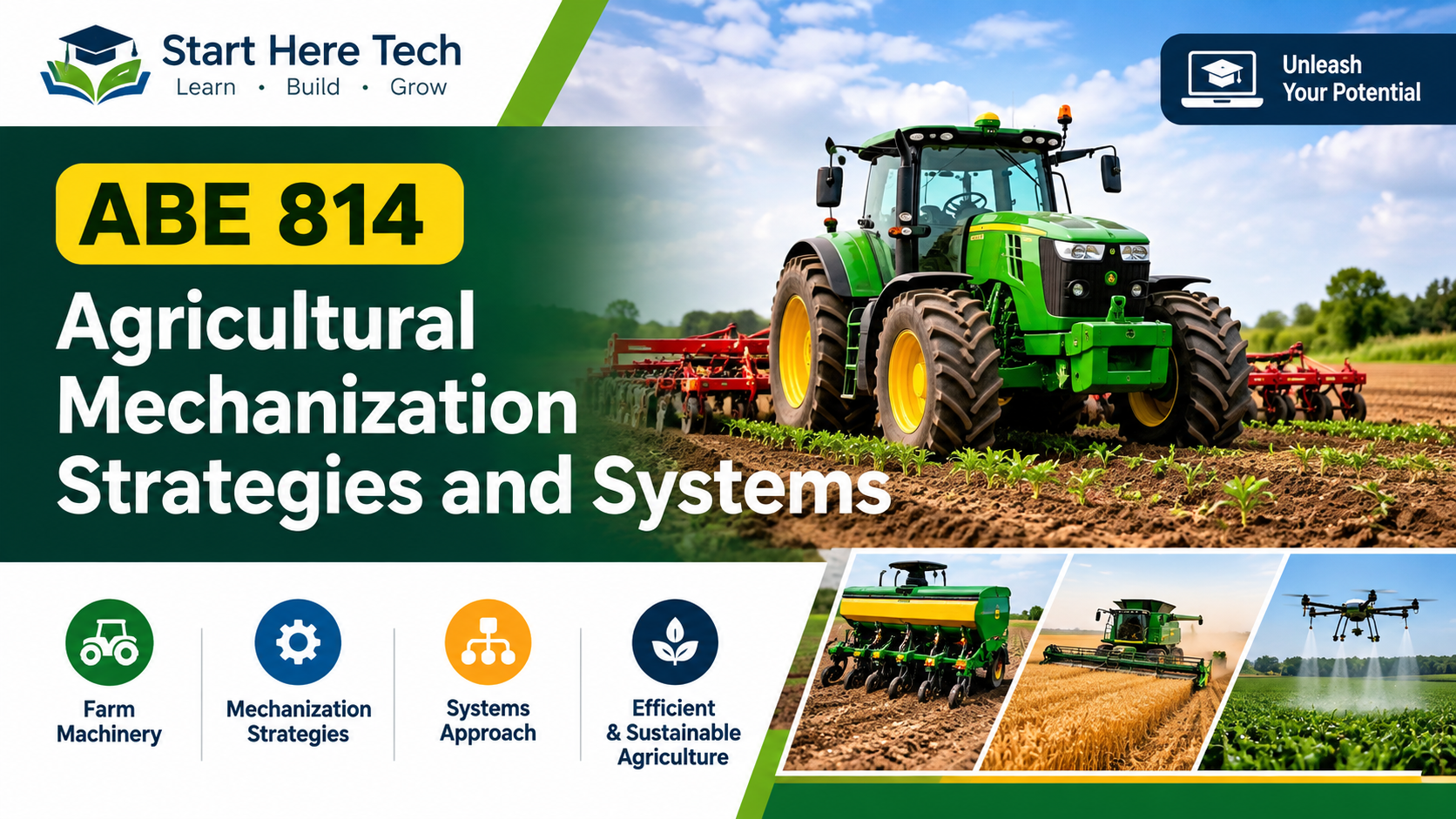
ABE 814: Agricultural Mechanization Strategies and Systems is a postgraduate core course for the Farm Power and Machinery option that equips students with the strategic and analytical competencies required to plan, select, optimize, and manage mechanization systems across the agricultural value chain. The course examines the selection and utilization of agricultural equipment for varied farm typologies; the engineering and computational optimization of tractor–implement combinations; strategies for mechanizing food processing and industrial raw material handling systems; and the economics of farm transportation. Emphasis is placed on systems thinking, quantitative decision tools, life cycle and economic analysis, and awareness of emerging technologies such as GNSS-guided machinery, telematics, automation, and digital mechanization advisory platforms. Through lectures, computational exercises, case studies, and a term project, students will develop the capacity to formulate mechanization strategies that are technically sound, economically viable, and contextually appropriate for smallholder, commercial, and industrial agricultural systems.
Show More

Course Content

Module 1: Agricultural Mechanization Strategy and Systems Development
This module lays the conceptual and policy foundation for ABE 814. It treats agricultural mechanization as a strategic discipline rather than a purely technical issue. This shapes the way governments, regions, and individual farms plan, finance, and manage farm power use. The vocabulary and frameworks built in Module 1 carry through the rest of the course. This ranges from equipment selection and tractor-implement optimization to food-processing mechanization and farm transport economics. Through four lessons, students will examine what agricultural mechanization covers as a sector. They will explore the economic, social, and environmental objectives a national mechanization strategy must balance; the range of farm power available to a farming system (from hand tools to emerging autonomous and smart technologies); how farm typology shapes mechanization needs; and how national and regional policy frameworks (including FAO's mechanization strategy guidelines and the FAO/African Union Sustainable Agricultural Mechanization Framework for Africa) translate these ideas into practice. The module also integrates recent peer-reviewed research to examine the governance challenges and contested claims surrounding mechanization in Africa. This enables students to engage with current debate rather than outdated assumptions.

Module 2: Selection and Utilization of Agricultural Equipment for Diverse Farming Systems
This module moves from strategy to practice: how a farm manager or advisor chooses and operates equipment once a mechanization direction has been set. Students examine the criteria that should drive equipment choice across different farm sizes, cropping patterns, and enterprise types; the ownership-versus-custom-hire decision that recurs throughout this course; and the planning and costing tools needed to keep equipment running efficiently over its full service life. The module closes by introducing precision-agriculture-enabled equipment, so students can evaluate when these newer tools are a genuine fit for a given operation rather than a default upgrade. Module 2 Lessons: 1. Criteria and Decision Frameworks for Agricultural Equipment Selection 2. Matching Equipment to Farm Power and Enterprise: Ownership versus Custom Hire 3. Equipment Utilization Planning and Life-Cycle Costing 4. Precision-Agriculture-Enabled Equipment: Variable-Rate Technology, Sensors, and Guidance Systems Estimated study time: approximately 6 to 8 hours across the four lessons, in addition to scheduled lecture time.

Module 3: Tractor–Implement Matching – Fundamentals
This module builds the engineering fundamentals behind one of the most consequential decisions in farm operations: pairing a tractor with the right implement. Students work through tractor power classification (drawbar, PTO, and hydraulic power), how to estimate the draft and power demands of common implements, and the physical principles of matching (weight-to-power ratio, ballasting, wheel slip, and traction efficiency). The module ends with field capacity and field efficiency computations applied across tillage, planting, spraying, and harvesting operations, setting up the optimization work that follows in Module 4. Module 3 Lessons: 1. Tractor Power Characteristics and Classification 2. Implement Draft, Power Requirements, and Traction Principles 3. Field Capacity, Field Efficiency, and Matching across Farm Operations Estimated study time: approximately 4 to 6 hours across the three lessons, in addition to scheduled lecture time.

Module 4: Optimization of Tractor–Implement Combinations
Where Module 3 establishes the fundamentals of matching, this module asks how to do it optimally. Students explore the criteria used to judge an optimal combination (minimizing cost per hectare and fuel or energy use, maximizing effective field capacity), the mathematical and simulation-based approaches used to get there, and the decision-support software and spreadsheet tools that make these methods usable in practice. The module also introduces telematics and GNSS/GPS guidance as tools for optimizing machine performance in real time and closes with applied case studies that tie the theory to representative farm operations. Module 4 Lessons: 1. Optimization Criteria and Objectives for Tractor–Implement Combinations 2. Mathematical, Simulation, and Software-Based Optimization Approaches 3. Telematics, GNSS Guidance, and Applied Case Studies in Optimization Estimated study time: approximately 4 to 6 hours across the three lessons, in addition to scheduled lecture time.

Module 5: Mechanization Strategies for Food Processing and Industrial Raw Material Handling Systems
Mechanization does not stop at the farm gate. This module extends the course's strategic lens into the post-harvest chain, covering the mechanization needs of drying, cleaning, sorting, milling, and storage, and the material handling systems (conveyors, elevators, pneumatic conveying, bulk handling, and packaging automation) that move raw material through a processing facility. Students then look at facility layout and material-flow optimization and at how automation, IoT, and Industry 4.0 concepts are reshaping agro-processing and raw material logistics at small, medium, and industrial scales. Module 5 Lessons: 1. Mechanization across the Post-Harvest and Processing Chain 2. Material Handling Systems and Facility Layout for Processing Plants 3. Automation, IoT, and Industry 4.0 in Agro-Processing and Raw Material Logistics Estimated study time: approximately 4 to 6 hours across the three lessons, in addition to scheduled lecture time.

Student Ratings & Reviews

No Review Yet
No Review Yet
Scroll to Top